

|
Telescopic Fishing Poles made of High Modulus Graphite Carbon manufactured in Japan, Very Powerful,
Lightweight and Sensitive.
8 - 9 Meters fishing poles
whips
10 - 11 Meters fishing poles
whips
12 - 16 Meters fishing poles
whips
The quality of the fishing rod you hold and the line you use are the two things that affect your sense of
feel. The rod blank and action determine the amount of vibration that travels from the bait up through the
line to the hand. Performance and comfort are extremely important. A quality rod is worth the price and
using nice rod will increase your fishing success. It is always better to purchase one best quality
fishing rod instead of using the same amount of money to buy several cheaper rods. Fishing pole is the
ultimate tool. Each one is scrupulously crafted to give you the lightest, strongest, most sensitive rod
available for the job at hand.
The advent of long pole whip is to allow us to fish of the far side hiding places, deep into the brush
where large fish hide. This pole allows you to place your bait exactly where you want it, as quietly as
possible, to get it in to the hard to reach places where reel rod can't. It will increase your comfort,
and you can catch more fish. This is a good rod with high level of sensitivity and decent level of power
with the rod's extra-sensitive tip, which allows you to feel even the smallest bites. Better rod
sensitivity will produce more hook-ups.
Very superior poles are great for the
carp fishing or
salmon fishing techniques. Each
model is built on a high-modulus graphite carbon, resulting in lightest, strongest, most sensitive rod
available, without added weight or increased blank diameter.
These fishing poles of the highest quality are lightweight and incredibly strong, thanks to a High Modulus Graphite Carbon
manufactured in Japan. We all know that when design and engineering are concerned the Japanese technology
is still the best in the world by far. Only the premium materials are used in their construction -- the
lightest, strongest, most sensitive blanks.
Length allows to get you deep
into the brush where large fish hide, in hard to reach places where reel rod can't. Very
Light Weight allows you to be
able to concentrate ground baits in very small areas of water with the utmost accuracy.
Flexibility and
Medium Soft Action allows you to see
the most delicate fish bites. If you got the right fishing gear your fishing experience will be much
better and much more enjoyable.
Fishing is always evolving with new equipment and we are staying on top of that tendency with the latest
technology to benefit every fisherman. Pole Fishing is an art form. Poles provide a level of precision
that a rod with reel just can't produce. You can't even imagine the fun you got when gently move the pole
against the fish to strike, ship the line to you, swing the fish to hand, unhook, re-bait and place pole
back in the water ready for the next fish. It is a very popular technique with match fishermen, and when
used in the hands of a professional, can result in a huge weight of fish. Just once you try pole fishing,
you'll ask yourself why it wasn't sooner.
It provides a tremendously wide variety of fishing from small silver fish to the hard fighting big fish,
including Carp on a lake,
Salmon on a stream or
Striped Bass on a bay. Catching
big fish is very challenging using these poles, and the advantages in skilful bait presentation are
outstanding.
Several helpful Tips
Never lift your catch, always play with the fish and use landing net to land it. Always extend and
insert telescopic sections very gently, try do not extend them too forcibly, try to keep it off the ground
to avoid dirt getting into the joints. Wipe it clean with a cloth before taking it down so you don't jam
dirt into the joint, rinse pole with freshwater after using it in saltwater as soon as you can. Always
remember to
take a good care of your poles and they will work for you for a very long time and will bring you large
amount of catches and a huge amount of great emotions. More great emotions - longer and healthier is your
life.
How to Attach the line to a Fishing Pole?
A single overhand loop on the braid lilian material connected to the pole's tip is all you need.
Next make a double knot on the fishing line.

|
After that put the loop over the braid lilian between the pole tip and the single overhand loop and
tide the line.

|
How to Extand and Insert Telescopic Carbon Pole.
You should open and close the rod with a special care, always keep control of the rod sections. Pole rods
can easily take even very heavy load, they are very strong and durable but they need to be handled with
cared too. They usually don't break while fighting the fish but they could break while they are being
closed without special care. Opening and closing these rods must be done very carefully and gently, no
sideway pressure should be applied to the rod while closing it.
Opening Telescopic Carbon Pole.
Telescopic poles are very simple to open, but there are a couple of points to keep in mind to simplify the
process and avoid damaging the rod:
Make sure to open the rod from the tip section to bottom one by one tightly and don't apply any sideway
pressure, so the sections can not move when twisted. Extend each section individually and make sure it's
snug but not too tight before moving on to the next section. Do not apply too much pressure when pulling
sections out as that could cause pieces to get stuck.
- Take off the plug at the end of the rod, pull out the tip with a lilian string by tilting the
rod a little.
- Expose the section with the braided string first and attach the line to the tip.
- Pull out the rod section by section sliding each part between the fingers, and screw the joint
of two sections till they are tightly fixed.
|

|
Once you're done shake the rod and see if you can hear any slight click signifying a "crack". If you do
that means that one of the sections is not fully extended, identify it and extend it properly.
Closing Telescopic Carbon Pole.
Telescopic rods are closed in the opposite direction, starting with the bottom section and collapsing them
all the way to the tip one. It's recommended to hold each section at its thickest point of the section
which is near the joint. Once again make sure not to apply any sideway pressure, use fingers, not palms,
place the bottom of the rod on a flat level stable surface and push each piece in. Once the section
becomes lose it will slide down.

|
- Loosen the joints by holding the two sides of joint and pull out while screwing, and draw in
by turns section by section from end.
- Attention should be paid when drawing in to avoid pulling too forcibly, which may hurt your
hand.
- Draw in the fishing rod from Butt section by turns. If in reverse, the end section may fall
into other sections, and maybe cause damage to fishing rod.
- Bending the fishing rod too forcibly or using fishing line when it is in disorder may cause
break of fishing rod.
|
If rod sections get stuck at a joint:
The most frustrating things that can happen to a telescopic fishing rod (after braking) is to become
jammed at a joint. Occasionally this can happen due to dirt/mud/sand in the joint but the main cause of
the joints fixed too tightly is extending the rod too forcibly.
Prevention is better than cure: try do not extend the rod too forcibly, try to keep your rod off the
ground at all times to avoid dirt getting into the joints. Wipe it clean with a cloth before taking it
down so you don't jam dirt into the joint. If you've been using it in saltwater give it a quick rinse with
freshwater as soon after use as you can. Its a good idea to put a protectant like WD-40, Tackle Guard or a
silicon lube on the joints.
When it happens there are several techniques to unstick the sucker.
A.
|
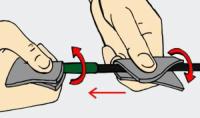
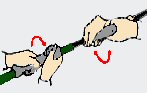
Try to force the thinner section in by twisting them, hold the anti-sliding place near joints with
the fingers and screw and press sections in reverse direction to loosen the joints but again make
sure not to use sideway pressure. You might try using rubber pads to increase the grip. Always
hold sections with your fingers close to joints.
|
|
|
Have a partner hold one side of the joint while you hold the other and gently twist and press
sections without using sideway pressure. Both of you hold sections with your fingers close to
joints.
|
B. Pour hot water on large side of the joint as close to the joint as you can to rapidly
expand it. Then after a few seconds try twisting or pushing the small side of the joint back down. Its
best if you can do this under a tap where the water starts off cold then gets progressively warmer over
a few seconds as this reduces the risk of stress cracks developing in the joint.
C. If the hot water technique fails try the next step up. Do the same as above but put ice
on the small side of the joint to shrink it. This is easiest if you get some ice from your freezer place
it on a cloth or towel and then wrap that around the rod and hold it while you heat the other side with
hot water.
D. Try a penetrating lubricant like WD-40, CRC or Tackle Guard. Leave the joint to soak for
an hour or two and then try gently to take the rod down.
E.
|
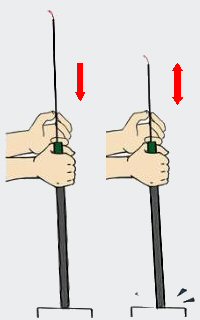
Stand the rod butt on a hard surface like concrete and hold it above the stuck joint. Gently lift
and lightly tap the stuck section on the ground. This works best if the lower joints are stuck.
For upper sections remove the plug of butt section, pull out the fixed two sections. Then put the
rod vertically on a not-too-hard plain ground (or put towel or other soft material on the ground),
hold the fixed joints and knock the ground. Never tap the tip on the ground as you are very likely
to break it. You can try to combine it with a lubricant or a hot water: pour hot water on large
side of the joint and lightly tap the stuck section against the bottom. Always remember to do it
very gently, not to apply any sideway pressure, hold larger section with your palms and thinner
section with fingers close to joints. Once the section becomes lose it will slide down.
|
|
Z. If nothing helped buy another rod from our website and take more care of your fishing
gear in the future!
How to land a fish.
Needless to say that landing a small fish is very straightforward with Poles, just raise it and slide the
fish into the landing net range. Catching bigger fish is always a challenge requiring patience and
knowledge especially with the light tackle. Of course it's a lot of fun.
|
If you believe that you hooked a big fish, don't raise your rod, keep it low at about 45 degrees or
even less to avoid breaking tip or top sections. Besides lifting the tip up will make fish fight
even harder and to start swimming off at high speed. You should instead lower the rod tip angle,
smoothly apply small sideway pressure, follow the movements of the fish, steering it away from the
danger areas and trying to bring it from the bottom into open water. There is no need to hurry, take
your time, let the fish get thoroughly exhausted, it will eventually come up and takes a gulp of air
which is the best opportunity to smoothly slide it into your landing net.
|

|

|
For really big fish make sure to bring the bottom section of the rod up to your head. Play with the
fish, let it go from one direction to another, use the rod's flexibility to steer the fish in your
desired direction. Making the fish swim around in different directions is the most typical method to
tire it before landing it in your net.
|
|
Another technique that works with longer Pole rods is to extend the rod all the way out past the
fish so that the fish is between you and the tip of the rod. If you apply a little pressure on the
line in the direction opposite to where you are, the fish will start struggling and moving towards
you which is exactly what you want to happen. You might also keep the tip of the pole right above
the fish to achieve the same result.
|

|
Take a good care of your rod.
|
Rod maintenance has nothing to do with rod breakage. Anglers will always find ways to break their
rods, starting from regular (car doors) to very stupid (standing on it) or while fighting a huge
fish. What should or should not be done to keep our fishing tackle in good shape and ensure many
years of fishing enjoyment?
|
|
1.
|
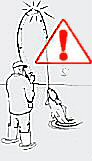
Never lift your catch, always play with the fish and use
landing net to land it. Never raise
your rod high with the large fish, keep your handle angle at about 45 degrees or less. All
graphite rods, are at risk of breakage if the rod is "high sticked". When the tip of the rod is
raised too high, the weaker tip section bears too much of the load and can easily break.
|
This is one of the most common causes of breakage and is 100% angler-caused.
2.
|
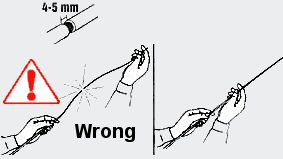
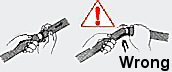
Always extend and insert telescopic sections very gently, try do not extend them too forcibly, try
to keep it off the ground to avoid dirt getting into the joints.
|
|
3. Remember, using heavier line and cranking down the drag may easily result in unexpected
graphite rod breakage. Graphite is less tolerant of abuse than fiberglass. Always remember your rod's
power rating and don't use fishing line or bait that is too heavy.
4. Be extra careful when getting your fishing rod out of the car, especially if it is a graphite
rod. Too many people break their rod on the car door.
5.
|
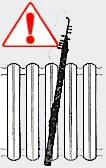
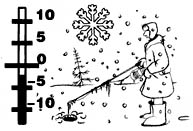
Don't remain the fishing rod in the back carriage of car for a long time. The long time sealed and
high temperature or very low temperature conditions are harmful for fishing rod.
|
|
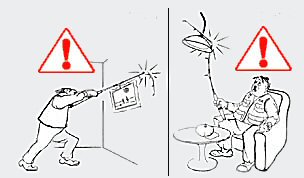
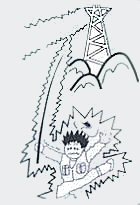
6. Always pay attention when fishing under or near the high voltage wire because of
electrical shock potentiality by high voltage wire and thunder. Carbon fiber is high
electricity-conductive material, so it is very dangerous if it touches electrical wire especially
when you are close to the water.
|
|
7. Wipe it clean with a cloth before taking it down so you don't jam dirt into the joint, rinse
rod with freshwater after using it in saltwater as soon as you can.
8. If you seal up the damp or sordid fishing rod, the moisture will possibly cause the bubbling
or scaling off of lacquer. To prevent this, always rub off the moisture on fishing rod and keep it in a
ventilated place. Never store a rod in its tube. Humidity can cause the moisture.
9. Always rub off the moisture, salt and dirt before storage.
|
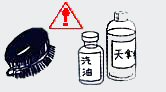
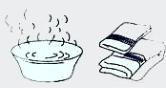
10. Never use brush, toothpaste, gasoline, dope and other organic substances to clean the
fishing rod, it may occur damage to rod surface and even the rod itself. Don't clean the rod by
steel brush. You shall gently remove the dirt, any remaining "fish stuff" or salt by towel, soft
brush or cloth dipped with a little soap and water, and after it is dry completely, brush up with
car wax or leather. This will make it easier to clean and help preserve the rod's finish. Wiping
the rod down with furniture polish after each use is a good way to keep it looking its best.
|
|
11. The best way to store a rod over long periods is to hang it in its case on a pin or clothes
hanger inside a wardrobe.
Always remember to take a good care of your rods and they will work for you for a very long time and will
bring you large amount of catches and a huge amount of great emotions. More great emotions - longer and
healthier is your life.
|
|
|