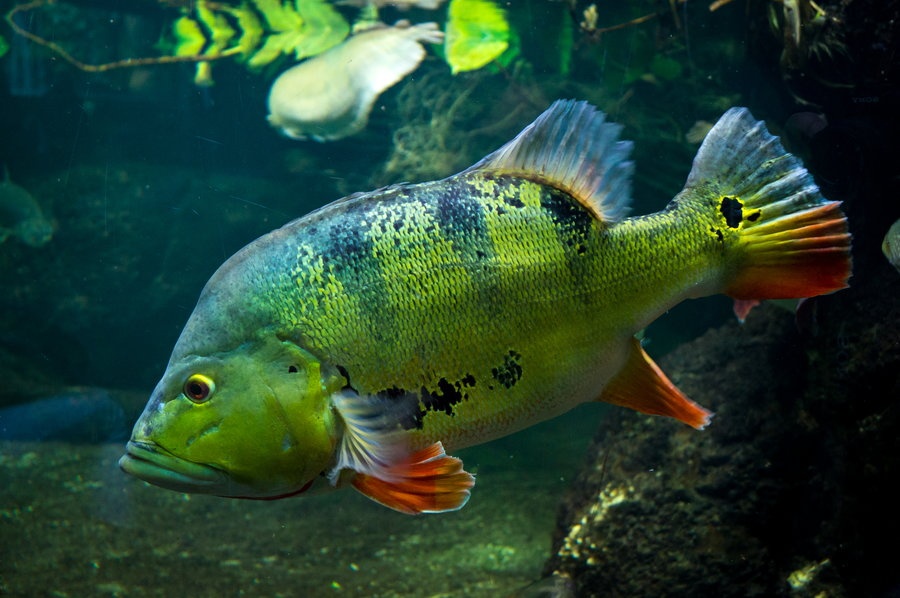
Peacock Bass Fish Identification, its habitats, characteristics, fishing methods.
Peacock Bass (by nature) is a fish species. Its native range includes the Amazon River basin of South America. Its diet includes warms, crayfish, crustaceans, insects, zooplankton and smaller fish. Adults can reach 55 centimeters.
Peacock Bass at a glance
Scientific name
by nature
Native range
the Amazon River basin of South America
Diet
warms, crayfish, crustaceans, insects, zooplankton and smaller fish
Maximum length
55 centimeters
The Peacock Bass, hard-hitting strikes, aerial jumps and line-stripping runs make it the ultimate game
fish for both the beginner or expert angler wanting to fly, artificial or live bait fish. Sport fishermen
have made these Bass prized game fish for their fighting qualities, so much so that many travel agencies
now arrange fishing trips to Brazil and Florida specifically to catch peacock bass. The peacock bass will
continue to be the world's most sought after freshwater sportfish, giving anglers the greatest fight they
will ever experience with a rod and reel. To do well in bass fishing, the best way is to study the
creature, where it lives, what environment and water temperatures they prefer, what type of bait or lure
better to use.
The Peacock Bass feed on warms, crayfish, crustaceans, insects, zooplankton and smaller fish. Bass loves
rocks and wooded areas and heavy covers. More knowledge about the Peacock Bass can surely help you to
increase your catch. Better knowing and understanding the bass feeding and spawning habits will make you a
more successful angler and will help to catch them considerably.
Peacock bass is the common name in English for several species of tropical, freshwater fish of the
genus Cichla native to the Amazon River basin of South America. These tropical fish are not true
basses, but are rather cichlids. They also inhabit the waters of Colombia, the Dominican Republic,
Malaysia, Panama, Singapore and parts of the USA (Guam, Florida, Puerto Rico, Hawaii, and the United
States Virgin Islands).
Description
The speckled peacock bass is the largest species and can grow up to 100 centimeters (three
feet, four inches) in length. The royal peacock bass is the smallest and grows to a maximum length of 55
centimeters (one foot, 10 inches). Also, most display three wide vertical stripes on their bodies and a
spot on their tail fins that resembles the eyes on a peacock's tail feathers -- a feature which resulted
in their English and Spanish common names. In addition, all adult males have a pronounced hump on their
foreheads. Other physical traits can vary greatly depending on the species, individual and stage of
development. These include but are not limited to: dark rosettes instead of stripes, light speckles and
impressive shades of bright green, orange, blue and gold. The stripes, however, tend to fade in late
adulthood.
A series of dark markings in the region of the abdomen that is covered by the pectoral fin
when it is pressed against the body. The caudal blotch is what has given the peacock bass its common name.
It starts as a dark spot covering 2 or 3 rays of the caudal (tail) fin. With maturity, the blotch becomes
larger and margined with a silvery or golden ring. The blotch is reminiscent of the eyes on a peacock
(bird) tail feather. All species of peacock bass appear to have a pattern of light spots on their sides
during at least some of their developmental stages. The spots may be more evident during non-spawning
periods of individual's reproductive cycles.
The color pattern includes large roundish blotches along the middle of the side,
corresponding to the position of the three numbered vertical bars. Juveniles specimens generally possess a
complete dark horizontal band extending from the head to the caudal fin base. In some species this band is
abbreviated. Usually disappears with maturity. An ocellus or ocellar blotch is a dark round marking
outlined with a light border color, resembling and sometimes called an eye-spot. Ocellated markings may
appear in various areas of the body including the tail (caudal blotch), the sides corresponding to the
vertical bars or scattered about the body. Prominent dark stripe above the gill cover and running
obliquely across the nape.
Black markings arranged in and around a horizontal band running from the eye to the
posterior edge of the operculum in juveniles. May be represented by irregular or isolated blotches or
small spots. Often referred to as cheek markings. Black or dark bars are present in some form in all
species. Three bars are arrayed on the sides below the dorsal fins. A fourth bar is found in some species
or individuals on the caudal peduncle.
Habitat and Habits
Successful in warm, slow flowing canals, ponds, lakes, deep rock pits, and lateral canals;
frequently found in shady areas around bridges, culverts, canal intersections, bends, dead ends, and near
fallen trees; spawns and often feeds in shallow water adjacent shorelines with overhanging vegetation;
cannot tolerate water temperatures below 60oF or salinities greater than 18 ppt.
The larger peacock bass in the pecking order always get their choice of habitat. Little fish
have to get out of the way or be eaten. As a result, you won't generally catch little fish alongside big
fish. In most cases, the trophy-size peacocks want to be in relatively deep water, near cover or in a
bottom trench in a lagoon. As elsewhere, water conditions are critical when fishing peacocks. Both clarity
and water level affect these fish. In most South American tributaries, waters are clear and dark. Turbid
water which flows into an area as levels rise may cause peacocks to actively feed.
The lagoons and lakes with a lot of cover in the form of standing timber or giant boulders
are prime places for big peacock. While most look more like little reservoirs, they are natural lakes off
rivers. They offer numerous features such as points and humps which attract peacock bass. They also have
"cuts" from the river that are likewise productive. Most shallow areas have some vegetation, and such
spots may hold a few smaller peacocks. The best areas, through, usually have a relationship to deeper
water; the thickest bush or tree in a bunch is often the best spot; two growing close to each other is
often good; an isolated bigger tree or bush away from a group also has a lot of potential, especially if
it lies near deeper water.
Feed almost exclusively on fish; tend to use great speed to capture prey; typically feeds
only during daylight hours; this fish has helped reduce the number of undesirable exotic fishes,
especially the spotted tilapia.
Spawning
Typically spawn from April through September with a peak in May and June; both adults
prepare a flat, hard surface near shore, then lay between 4,000 and 10,000 eggs; young are guarded by both
parents, sometimes for several months; males commonly develop a �nucchal� hump on foreheads when
reproductively active.
Peacocks grow to sexually mature sizes between 11 and 13 inches in less than 12 months, while the speckled
peacock take three years to become sexually mature. Spawning normally takes place on a flat surface that
has been cleared (or is bare to begin with) of algae or other debris during the fanning movements of the
parents. This could be on the top of a stump or the bark of a fallen tree that lies horizontal below the
surface, yet near to the depression beds. The female moves over the bed and deposits neat rows of eggs as
the male follows and exudes sperm which drifts down over each row. This effort usually takes several
hours. Female peacocks may lay an average from 3,000 to 10,000 eggs, with an average being about 5,000.
The color of the eggs reportedly change from a white to a yellow as they develop.
Underdeveloped eggs accumulate a fungus and are normally removed from the bed by the parents. Ultimately,
less than one percent of the eggs will hatch and reach adulthood. The eggs, while being constantly fanned
by the female, develop into larvae in about two days.
As the eggs hatch at the spawning site, the male (and sometimes the female) takes them into
his mouth and deposits the fry in the nearby small depression beds. The larvae have a mucous-like adhesive
at their head which allows them to stick to the bottom of the nest. They wiggle their tails, making the
floor of the bed resemble a writhing mass of undulating worms.
At night, the parents lower themselves over the bed to discourage nocturnal predators from
attacking the larvae. Both parents stand vigil and guard the brood which mill about their nest deriving
nutrition from the remnants of their yolk sacs.
As the fry become free-swimming, which occurs about three days after the hatch, the parents
herd them around the canal. The fry stick together in a cloud near the surface of the water. They feed
throughout the day on zooplankton, growing rapidly and becoming stronger.
Fishing Methods are spin-casting, still fishing, Bait-casting and pole fishing. The most common techniques for
catching them are similar to those for catching largemouth bass with the notable exception that peacock
bass usually won't strike artificial worms -- a widely used lure among largemouth bass fisherman. In
addition, fly fishing techniques, including lures such as poppers and large streamers, are becoming
increasingly popular for catching these cichlids. Casting a lure to the deep water off a shallow point or
"saddle" that drops quickly can be very productive. Waters without the benefit of a sharp drop or other
defining structure that are over six feet deep, should generally be trolled. Waters of less depth and more
large obstacles (whether boulders or submerged trees) should be cast.
Like no other freshwater fish in the world, peacocks are the ultimate in violent strikes and
sheer fighting power. One of the world's toughest freshwater species, the peacock bass delivers
bone-jarring strikes, aerial acrobatics and line-stripping runs -- making it the ultimate quarry for both
the fly and plug angler. Put that together with the whole Amazon travel experience and you have the
fishing adventure of a lifetime. The peacock bass, by nature, is aggressive and its personality is
downright belligerent. It is a fish so powerful that it can destroy tackle, straighten some hooks and tear
hardware right out of some hardwood and hard plastic baits. The fiercest fighting fish in the world may
mangle poorly-constructed lures and even break them apart, and then give you the battle of your life.
Most shallow areas have some vegetation, and such spots may hold a few smaller peacocks. The
best areas, through, usually have a relationship to deeper water; the thickest bush or tree in a bunch is
often the best spot; two growing close to each other is often good; an isolated bigger tree or bush away
from a group also has a lot of potential, especially if it lies near deeper water. The edge of the woods,
timber around a depression, and the edges of fairly large openings in thick wood areas also can be very
productive.
Another way to check out the larger lagoons in South America is to troll down the middle.
Once you've found the peacock's hangout, there should be others in the area. You can stop and cast in the
same vicinity (middle of that lagoon) and catch plenty of big fish. It's been my experience, however, that
mid-size and smaller peacocks generally are not in the middle; they are hiding under cover along the bank.
Most popular sportfish in southeast Florida coastal canals where it generates millions of
hours of fishing pleasure for thousands of anglers who spend more than $8 million a year to catch them;
available to both boat and bank anglers using the same basic tackle as largemouth bass anglers; small
shiners are the preferred live bait; rarely take plastic worms like largemouth bass do, but top-water
lures, minnow imitating crank and jerk baits, and marabou jigs are popular artificial baits; streamers,
epoxy minnows and pencil poppers are favorites of fly fishers. Their flesh is white and sweet when cooked,
and has very little oil, making it similar in taste to snapper or grouper. Also, they are not excessively
bony.