


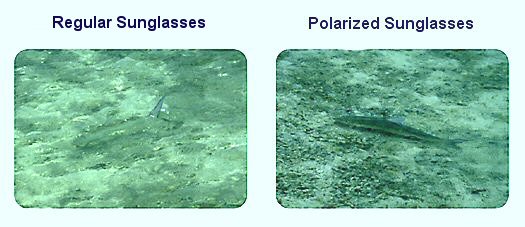



Enjoy your fishing day with Protective Polarized Sunglasses.
Sunglasses with polarized lenses are the best available due to their ability to dramatically reduce glare.
POLAROID Polarized Sunglasses
MAUI JIM Polarized Sunglasses
OAKLEY Polarized Sunglasses
Benefits
Who and Why Should Wear Polarized Sunglasses?
Any surface can be a source of glare: water, sand, wet or dry pavement, buildings, windshields, ice, snow.
Glare can be 7 to 10 times brighter than ambient light and can be as much as 65% of the light seen.
Simply, just the dark lenses do not eliminate the problems of glare. Darkly tinted lenses reduce
brightness, but they do not reduce glare like a polarized lens. In fact dark lenses without added UV
protection could conceivably cause more damage to the eyes than if they were wearing no sunglasses at all.
Here is why, a dark lens can cause the pupils to dilate and let in more light, also lets in more UV.
Polarized lenses minimize glare and UV transmission.
POLAROID Polarized Sunglasses
Polaroid is a world leader in polarized lens technology and one of the world's best known and most trusted eyewear brands. The Polaroid brand has a unique history of innovation and style and remains a leader in technology and innovation. Polaroid stands for full protection, perfect vision and great styling and offers a variety of superb eyewear collections.- Block out virtually 100% of glare.
- Thermofusion Technology gives clearer, truer vision with no shape-shifting side effects.
- Enhanced contrasts ensure greater visual definition.
- Block glare to give you a correct color perception and to see everything in perfect clarity
- Protect against the sun's harmful UVA, UVB and UVC rays
- Tested to withstand all sorts of impact and thereby protect the eye.
- No squinting and no straining for all day comfort.
- The high quality lenses, lightweight frames are especially made for continuous comfortable wear all day long.
- Thanks to the extra scratch-resistant layer, the lenses can take everyday knocks and look good as new.
- Thanks to their flexibility they're less breakable.
- They are safer, lighter and less expensive than glass lenses, they are great for everyday living.
Polaroid Premium X 4316/S Sunglasses.
A brand-new, unused, and unworn 100% Authentic Polaroid Sunglasses in the original packaging and with the original tags. They includes UV coating that protects your eyes from the following: UVA - possible cataract formation, retinal damage with long term exposure.UVB - potentially the most hazardous, can damage the retina and the conjunctiva, as result blindness.
UVC - does not reach the earth surface as it is absorbed by ozone layer.


- Style: Polaroid X 4316/S.
- Collection: Polaroid Eyewear collection.
- Shape: Aviator.
- Bridge Shape: Single Bridge.
- Gender: Mens.
- Frame Material: Metal.
- Temple Material: Acetate.
- Hinge Type: Flex.
- Rim Type: Full Rim.
- Lens Material: Glass Polarized 100% UV protected.
- 100% UVA, UVB, UVC rays protected.
- Frame & Lens Color: Available in 2 colors:
- 0A4X A- Gunmetal ( 0P green polarized lens)
- 000U B- Gold ( 2P brown polarized lens)
- Eye size: 60 mm.
- Bridge Length: 15 mm.
- Temple Length: 135 mm.

Package Contents:
- New Authentic Polaroid X 4316/S Sunglasses.
- New Authentic Microfiber Cleaning Cloth.
- New Authentic Polaroid Case.
The Polaroid X 4316/S Sunglasses was created to be an amazing looking option to be certain your vision remains unharmed from the sun's strong ultra-violet rays. Made working with long lasting and dependable elements, this impressive pair of Sunglasses from the eyewear authorities at Polaroid will supply you with a long time of reliable and efficient use. Your eyes are one of your most essential resources, and the Polaroid X 4316/S Sunglasses is the best strategy for keeping that resource contented and strong. Polaroid has been in the market of generating premium quality sunglasses for a long period of time and the Polaroid X 4316/S Sunglasses are the direct result of their determination to making sure that you have got a marvelous pair of sunglasses that will be in use for years and years. For the best way to be assured that you look terrific and are protecting your eyes, elect the Polaroid X 4316/S Sunglasses.
Back to top
Polaroid Premium X 4317/S Sunglasses.
A brand-new, unused, and unworn 100% Authentic Polaroid Sunglasses in the original packaging and with the original tags. They includes UV coating that protects your eyes from the following: UVA - possible cataract formation, retinal damage with long term exposure.UVB - potentially the most hazardous, can damage the retina and the conjunctiva, as result blindness.
UVC - does not reach the earth surface as it is absorbed by ozone layer.


- Style: Polaroid X 4317/S.
- Collection: Polaroid Eyewear collection.
- Shape: Semi-Rectangle Aviator.
- Bridge Shape: Single Bridge.
- Gender: Mens.
- Frame Material: Metal.
- Temple Material: Acetate.
- Hinge Type: Flex.
- Rim Type: Full Rim.
- Lens Material: Glass Polarized 100% UV protected
- 100% UVA, UVB, UVC rays protected.
- Frame & Lens Available in 3 colors:
- 0A4X A- Gunmetal ( 0P green polarized lens)
- 0KIH B- Black ( 1T gray polarized lens)
- 0C9O Dark Brown ( 2P brown polarized lens)
- Eye size: 59 mm.
- Bridge Length: 17 mm.
- Temple Length: 135 mm.

Package Contents:
- New Authentic Polaroid X 4317/S Sunglasses.
- New Authentic Microfiber Cleaning Cloth.
- New Authentic Polaroid Case.
Made to be an amazing looking manner to keep your eyes sheltered from the sun's uv rays, the Polaroid X 4317/S Sunglasses will meet virtually any social situation. This pair of Sunglasses from the eyewear professionals at Polaroid are made by using several of the best materials and assembly obtainable on today's market. Your eyes are one of your most vital resources, and the Polaroid X 4317/S Sunglasses are the most suitable manner to keep that useful resource operating at optimum performance. Polaroid has been part of the business of developing high caliber sunglasses for a very long time, and the Polaroid X 4317/S Sunglasses are the end result of their initiatives to assure that you have a pair of sun glasses that are resilient and will not burst your bank account. Polaroid X 4317/S Sunglasses is the best choice for all of your eyewear expectations, for a brilliant way to keep your eyes secured.
Back to top
Polaroid Polarized Sunglasses PLD7009 VRAAH classic Black/Red Grey.
A brand-new, unused, and unworn 100% Authentic Polaroid Sunglasses in the original packaging and with the original tags. They includes UV coating that protects your eyes from the following: UVA - possible cataract formation, retinal damage with long term exposure.UVB - potentially the most hazardous, can damage the retina and the conjunctiva, as result blindness.
UVC - does not reach the earth surface as it is absorbed by ozone layer.


- Condition: Brand New
- Manufacturer: Safilo Group
- Brand: Polaroid
- Gender: Mens
- Type: Sunglasses
- Model: PLD 7009-S-X VRA/AH 57mm
- Frame Color: Matt black and red
- Frame Shape: Rectangle
- Frame Style: Full Rim
- Frame Material: Acetate
- Lens Technology: Polarized
- Lens Color: Grey
- Lens Material: Ultra Light Plastic
- Lens Treatment: Mirrored
- Eye Size: 57mm
- Bridge Size: 15mm
- Temple Size: 140mm
- UPC: 762753363077
- UV Protection: 100% UVA & UVB
- 100% Authentic & Genuine
- New Authentic Polaroid PLD 7009-S-X VRA/AH Sunglasses.
- New Authentic Microfiber Cleaning Cloth.
- New Authentic Polaroid Case.
The Polaroid PLD 7009/S is a perfect Sunglasses which paired with polarized lenses. Their highly
reflective properties reflect heat, glare, and can enhance visual comfort. The width of the bridge of this
frame is 15 millimeters. The eyesize of this item is 57 millimeters. The length of the temple pieces are
140 millimeters. It's nature's color for water and sky. Polarized lenses remove nearly 100% of surface
glare from the environment around you, and are highly recommended for all outdoor activities. It is fully
rimmed along the edges to give a sense of completeness, lens security, toleration and absolute style.
These Sunglasses made by Polaroid are brand new & 100% authentic. They are made from a high-quality
Acetate for durability and comfort they are light, strong, and hypoallergenic. The non-slip temples and
integrated nose pads will prevent wobble while the optical hinges will provide a nice fit.
Moreover, the Plastic comes with patented technology that prevents glare on glasses for improved vision.
They are one of the best polarized fishing sunglasses on the market.
Polaroid Polarized Sunglasses PLD 7023/S OIT/OZ Black/Red.
A brand-new, unused, and unworn 100% Authentic Polaroid Sunglasses in the original packaging and with the original tags. They includes UV coating that protects your eyes from the following: UVA - possible cataract formation, retinal damage with long term exposure.UVB - potentially the most hazardous, can damage the retina and the conjunctiva, as result blindness.
UVC - does not reach the earth surface as it is absorbed by ozone layer.


- Condition: Brand New
- Manufacturer: Safilo Group
- Brand: Polaroid
- Gender: Mens
- Type: Sunglasses
- Model: PLD-7023-S-OIT-OZ 56mm
- Frame Color: Matt black and matt orange
- Frame Shape: Square
- Frame Style: Full Rim
- Frame Material: Plastic
- Lens Technology: Polarized
- Lens Color: Red
- Lens Material: Carbon Fiber
- Lens Treatment: Mirrored
- Eye Size: 56mm
- Bridge Size: 18mm
- Temple Size: 140mm
- UPC: 716736085777
- UV Protection: 100% UVA & UVB
- 100% Authentic & Genuine
- New Authentic Polaroid PLD 7023/S OIT/OZ Sunglasses.
- New Authentic Microfiber Cleaning Cloth.
- New Authentic Polaroid Case.
The Polaroid PLD 7023/S is a perfect Sunglasses which paired with polarized lenses. The Carbon Fiber comes
with patented technology that prevents glare on glasses for improved vision. They are one of the best
polarized fishing sunglasses on the market.Their highly reflective properties reflect heat, glare, and can
enhance visual comfort. The width of the bridge of this frame is 18 millimeters. The eyesize of this item
is 56 millimeters. The length of the temple pieces are 140 millimeters. It's nature's color for water and
sky. Polarized lenses remove nearly 100% of surface glare from the environment around you, and are highly
recommended for all outdoor activities. It is fully rimmed along the edges to give a sense of
completeness, lens security, toleration and absolute style.
These Sunglasses made by Polaroid are brand new & 100% authentic. They are made from a high-quality Rubber
for durability and comfort, they are light, strong, and hypoallergenic. The non-slip temples and
integrated nose pads will prevent wobble while the optical hinges will provide a nice fit.
Moreover, the Plastic comes with patented technology that prevents glare on glasses for improved vision.
They are one of the best polarized fishing sunglasses on the market.
Maui Jim Polarized Sunglasses
Maui Jim Sunglasses, one of the most recognised optical brand in the world for sheer quality and character. Only Maui Jim use their own PolarizedPlus`2 Technology that block glare and UV protected from all angles and filters out 100% of UVA/UVB/UVC & harmful blue light and then boost colors for unmatched color. The precise co-ordination between the lens and the human eye offers maximum clarity at all angles of vision across the entire lens. Maui Jim Sunglasses have scratch/impact resistant lightweight polarized lenses, 20% thinner and lighter, that provide superb optical clarity. All Maui Jim styles are manufactured in Japan or Italy.OAKLEY Polarized Sunglasses
Oakley Sunglasses, the most recognised optical brand in the world for sheer quality and character. Only Oakley have HD-Polarized Glare reduction via technology that produces the best polarized lenses on the planet with 99.99% polarization efficiency. PLUTONITE lens material with UV protection that filters out 100% of UVA/UVB/UVC & harmful blue light up to 400nm. Oakly make of dual lens polaric ellipsoid geometry (two lenses cut from single toric shield). The precise co-ordination between the lens and the human eye offers maximum clarity at all angles of vision across the entire lens.Benefits, Who and Why Should Wear Polarized Sunglasses?
Benefits
Lenses reduce glare, not brightness, allowing greater transmission of light for better vision.Polarized sunglasses are designed to fight the glare coming from high glare water surface. Polarized lenses are very helpful when driving to reduce those annoying bright reflections of the sun on the cars ahead, the glare on your car or the road. The reason is that the surfaces that you see on the car in front of you (the back window, the trunk door, and even the roof) will be slanted towards you, while the sun will be more or less aligned in the vertical plane through both cars. The sunglasses will help more with the reflections from the glass than from the metal as the former are polarized to a higher degree. The direction of polarization will change with the direction of the road with respect to the position of the sun. If the sun is in front, behind, or high above, the road brightness will tend to be horizontally polarized and the filter of the sunglasses will help. Of course, if the road is wet you get the same anti-glare power than at sea.
Who Should Wear Polarized Sunglasses?
Traditionally, polarized lenses have been recommended for people who participate in water sports such as boating and fishing. The lenses can allow them to see past the surface of the water by reducing the reflecting glare. People participating in other outdoor activities such as tennis, golf, running, skiing and biking, can also benefit from polarization. The reflections off the court, snow, sand, or road can result in an enhanced visual comfort that cannot be realized with non-polarized lenses.Back to top
Most People Can Benefit
Polarized lenses have features that can a benefit anyone who wears sunglasses. They improve visual comfort and reduce eye strain by reducing reflecting glare.Because haze has the effect of horizontally polarizing overhead sunlight, vision through haze will be improved with polarized lenses. The reflected image of the dashboard off the windshield of a car can be a distraction when driving on a sunny day. Polarized lenses will nearly cancel this reflected image, providing an uninterrupted view from the windshield.
Effects of UV Radiation
It is well known that UV radiation can cause skin damage, but many are unaware of the potential danger UV radiation has on the eyes. Recent medical literature has expressed concern about the potential eye damage caused by long term exposure to ultraviolet light. To protect our eyes, we need sunglasses that eliminate glare from reflective surface and reduce UV light transmission. Polarized sunglasses are an excellent way to eliminate both glare and UV light.Back to top
Some Frequently Asked Questions:
1. What is the difference between a polarized lens and an ordinary tinted lens?While ordinary tinted lenses reduce brightness, only polarized lenses eliminate glare.
2. Do polarized lenses provide U.V. protection?
Polarized lenses afford 99% absorption at 380 nanometers.
3. Can polarized sunglasses have AR coating?
Yes, however it is generally recommended that only the back side of the lens is coated to minimize the halo effect from light entering from behind.
4. Can polarized sunglasses have Mirror Coating?
Mirror coating can be used to enhance polarized lens protection or to make a fashion statement. These lenses can also reflect heat and come in various colors. A blue mirror coating over grey polarized lens is a popular general purpose choice.
5. Are polarized sunglases UV protective?
Most polarized lenses offer inherent UV protection from UVA and UVB rays.
Back to top
|| Home
|| Site Map
|| Help
|| About Us
|| Contact Us
||
Copyright© 2004-2026 All Fishing Buy. All rights reserved.
Copyright© 2004-2026 All Fishing Buy. All rights reserved.


🎣 Fishing Expert
AllFishingBuy Assistant
Hi! I'm the AllFishingBuy fishing expert. Ask me anything about our rods or fishing techniques — I'm happy to help you find the perfect rod! 🎣
Live Chat